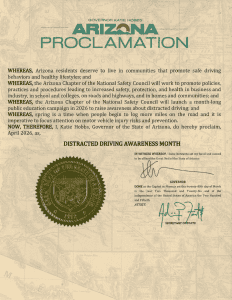
Governor Katie Hobbs has officially proclaimed April 2026 as Distracted Driving Awareness Month in Arizona. The designation brings statewide focus to a safety issue that continues to cost lives every day.
“No one should lose their life over something as preventable as a distracted moment behind the wheel,” says Rick Murray, President and CEO of Arizona Chapter National Safety Council (ACNSC). “Each of us has a role in keeping our roads safe, and it starts with making the decision to drive without distractions every time.”
The Reality Behind the Numbers
In 2024, more than 3,000 people died in distraction-affected crashes. That equals about nine lives lost every day, according to the National Highway Traffic Safety Administration.
That number likely falls short.
There is no standard method to track distraction in crash reports. Drivers may not admit they were distracted. In some cases, the driver responsible doesn’t survive the crash. Investigators rely on limited evidence and statements.
What Distracted Driving Means
Distracted driving is any activity that pulls attention from the road. That includes:
- Using a phone
- Adjusting navigation or music
- Talking with passengers
- Eating or drinking
- Interacting with in-vehicle screens
Safety experts point to inattentional blindness as a key factor. You can look straight ahead and still miss a hazard because your brain focuses on something else. That means the danger isn’t just slower reaction time. It’s failure to react at all.
Why This Keeps Happening
People assume short actions carry low risk. A quick glance at a phone. A fast reply. A short adjustment on a screen.
Research from the National Safety Council shows hands-free technology does not remove distraction. It shifts it. Your hands stay on the wheel, but your attention moves away from driving.
The brain doesn’t multitask well. It switches between tasks. Each switch creates a gap in awareness. On the road, that gap can lead to a crash.
What Drivers Can Do
Take these steps before and during every trip:
- Put your phone on Do Not Disturb before driving
Silence removes the trigger to check notifications. - Program navigation before starting the trip
Set your route while parked. Avoid mid-drive adjustments. - Avoid interacting with in-vehicle screens while driving
Built-in systems create the same distraction as phones. - Pull over safely if something requires attention
If it cannot wait, stop the vehicle first.
These actions work because they remove decisions in the moment and set a clear standard before you start driving.
The Role of Employers and Communities
Distracted driving affects more than individual drivers. It impacts workplaces, fleets, and public safety across the state.
Employers play a direct role. They can:
- Set clear policies on device use while driving
- Train employees on distraction risks
- Model safe behavior at leadership levels
- Track and reinforce compliance
Communities can support change by:
- Promoting awareness efforts
- Supporting enforcement of traffic laws
- Sharing accurate safety information
- Encouraging open conversations about driving habits
Consistency across work and home environments strengthens the message and makes safe behavior easier to follow.
A Simple Standard Going Forward
Distracted driving remains one of the most persistent and preventable threats on our roadways. The solution is consistent behavior.
This month, and every month, the Arizona Chapter National Safety Council calls on all drivers to make distraction-free driving the norm, not the exception.
To learn more about ACNSC’s resources for driver safety, visit our distracted driving awareness page.
Driving demands our full attention. Nothing matters more than getting home safely.